
Jackson Parish Projected vs Actual
A projected release date estimates when a sentence calculation could permit departure from custody. Louisiana DPS&C says its automated locator can provide that date when applicable. The result reflects the commitment and calculation in the state record at that point. It can change before the gate event. An actual release date records what occurred after staff processed the release, transfer, or discharge.
For a Jackson Parish pretrial detainee, there is usually no computed sentence-end date. A bond amount is not proof that bond was posted. A dismissal or time-served minute can authorize release, but another case or detainer can keep the person in custody or lead to transfer. The Jackson Parish Correctional Center release screen and court minute should be matched to establish both authority and physical exit.
A sentenced person can also have several dates that answer different questions. Parole eligibility is when consideration may begin under the applicable law. A diminution date reflects earned sentence reduction. A full-term date reflects the sentence without that earlier release path. The actual release event can lead to parole, another form of supervision, transfer, or full discharge.
Locate a Jackson Parish Release Date
Classify the custody before searching. The Jackson Parish live inmate feed is a current-booking source and has no verified projected-release field. A state prisoner’s official calculation belongs to DPS&C even if that person is housed in a parish facility. A local court sentence requires the court and jail record. This split prevents a county booking date from being mistaken for a state release calculation.
- Gather the full name, date of birth, booking number, court docket, and DPS&C number if one exists.
- For a state sentence, use the Louisiana DPS&C Inmate Information page and automated locator at (225) 383-4580. The phone system accepts a DPS&C number or name and date of birth.
- Record the projected date exactly as given, along with the access date, housing assignment, and agency. Do not restate it as a promise.
- For a parish sentence, obtain the sentence, commencement date, jail-credit notation, and any later court minute. Ask the jail which release date its management record currently calculates or records.
- If computation is incomplete, ask whether DPS&C has received all sentencing documents. Missing or late commitments can delay a date.
- For formal proof, request the master prison record or the specific releasable calculation fields. After departure, verify the release event and supervision status.
The Jackson Parish release-record workflow explains how to pair the jail event with the legal order. That pairing is vital when a person disappears from the current roster. Absence may mean release, transfer to DPS&C, another jurisdiction’s pickup, an ICE event, or a publication change.
Note: The DPS&C web and phone channels may expose different fields, so preserve the source and access date with any projected result.
Jackson Parish State Date Records
The DPS&C automated locator can report a housing assignment, facility contact, and projected release date when applicable. Louisiana’s LAVNS search, accessed through VINELink, can show custody or community-supervision information supplied to the state network. DPS&C describes LAVNS as updating every 24 hours. Neither public interface replaces the master prison record.
The official DPS&C locator instructions also distinguish records correction routes. A state-facility prisoner contacts the facility Records Office. A DPS&C prisoner held in a local facility uses the Department’s administrative-remedy process. The captured official page shows the public locator and the route for sentence or release-date issues.
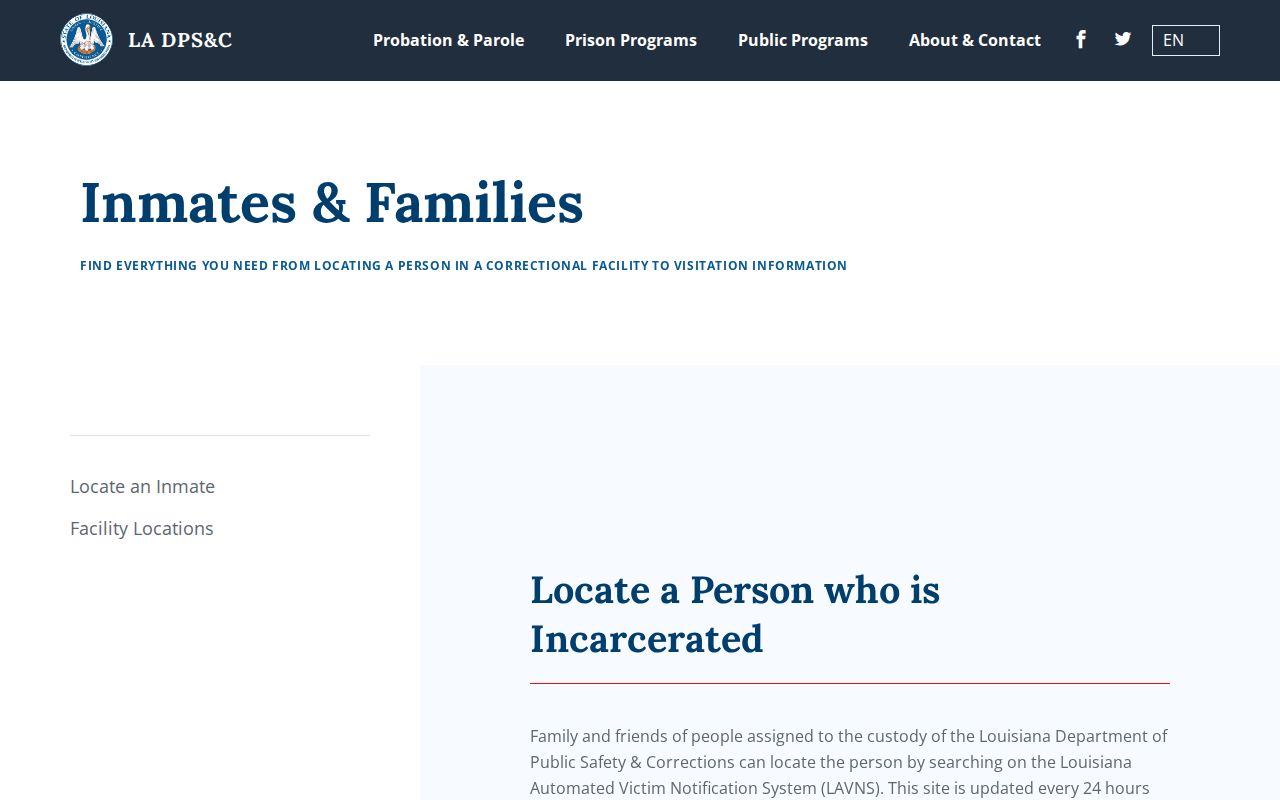
This official source supports using the state calculation record for a Louisiana sentence rather than asking a local jail to resolve a DPS&C computation.
DPS&C also lists automated time-computation information at (225) 342-0799. A caller should have the state identifier and the controlling court information ready. If a court minute, jail-credit amount, or sentence structure appears wrong, identify the precise conflict and follow the correction channel instead of trying to recalculate from a public summary.
Jackson Parish Good-Time Date Split
Louisiana does not use one good-time percentage for every Jackson Parish sentence. The offense date, conviction type, prior status, sentence, and statutory exclusions control. This is the central reason a generic online release calculator is unsafe.
For eligible felony offenses committed on or after August 1, 2024, La. R.S. 15:571.3.1 creates a separate framework. Its core provision caps diminution at fifteen percent of the sentence, which is often described as an 85-percent service structure. The law includes exclusions, including specified sex offenses and habitual-offender convictions. It also describes how the remaining portion is served after an eligible release, subject to the statutory sentence structure.
Earlier offenses remain subject to La. R.S. 15:571.3 and the version that applies to the offense date. That law contains different categories and ratios. For example, current text addresses parish sentences without hard labor, specified violent-offense categories, and DPS&C felony categories in different ways. The sheriff where the conviction occurred has a defined role for applicable parish credits, while state sentence calculations remain within DPS&C’s record framework.
A claim that all Louisiana prisoners serve exactly 85 percent is therefore false. One 85-percent concept comes from the newer fifteen-percent cap. Another can arise from an older ratio for a specific category. Many sentences fall under other rules or have no diminution eligibility. The live statute, offense date, sentencing papers, and official calculation must be read together.
Note: Good time changes a computed sentence path; it does not turn the projected date into proof that Jackson Parish custody actually ended.
Compute Jackson Parish Sentence Dates
An accurate official calculation begins with the court’s sentence, commencement date, and jail credit. Staff then identify concurrent or consecutive terms, the law tied to the offense date, and any exclusion. Only credits actually earned and posted belong in the calculation. Disciplinary forfeiture, restoration, program credit, amended court action, or a new sentence can alter the result.
The following factors explain why two people with similar sentence lengths may have different projected dates:
| Factor | Possible effect | Record to check |
|---|---|---|
| Offense date and category | Selects the governing good-time law and exclusions | Charging and conviction record |
| Jail credit | Changes credited time already served | Sentence minute and master prison record |
| Concurrent or consecutive terms | Changes how multiple sentences run | Commitment and later clarifying order |
| Earned or forfeited credit | Moves a diminution date earlier or later | DPS&C calculation and disciplinary record |
| Parole action | Creates a different possible community-release path | Board decision and parole certificate |
| Detainer or hold | May turn departure into transfer instead of community release | Custody and receiving-agency records |
| Corrected court papers | Can require recalculation | Amended minute, commitment, and master record |
Parole eligibility under La. R.S. 15:574.4 is not the same as the projected good-time or full-term date. Eligibility permits consideration under the correct statutory track. The Board may grant, deny, defer, modify, or rescind an action before actual release. Even a grant can carry conditions and a later date.
The hearing calendar is useful for locating a scheduled matter, but it is not a released-person database. Louisiana posts parole dockets by hearing week. A listed name proves only that the matter was placed on an agenda. The Board states that eligible people are generally scheduled within nine months of eligibility, which describes scheduling rather than a release deadline. A decision may be announced or recorded later, and a set date may still be changed before the person signs the parole certificate and physically leaves custody.
For that reason, keep parole dates in separate fields when organizing a Jackson Parish record. Note the eligibility date, hearing date, decision date, any date named in the decision, actual DPS&C release date, and supervision start. If a decision is later rescinded or modified, preserve that action too. This timeline avoids turning a favorable decision into a false gate date and makes later release verification much clearer.
Jackson Parish Jail vs State Dates
A person at Jackson Parish Correctional Center can be a local detainee, a locally sentenced person, a DPS&C prisoner housed in the parish, or a person held for another authority. Sheriff Andy Brown's local custody records do not decide which release-date system controls. Ask whose legal custody governs the sentence.
A pretrial local case turns on court action, bond, and holds. A parish sentence requires the court commitment, jail credit, and the applicable parish-credit record. A DPS&C sentence follows the statewide locator and master prison record even when the bed is local. Placement at the Jackson Parish Transitional Work Program remains custody, not release. For each path, a transfer date must not be relabeled as a community-release date.
If a clerk minute says “credit for time served,” ask whether staff processed an exit and whether another hold existed. If the jail says “no longer here,” ask for the release type and receiving agency. The release screen supplies the event; the court or state record supplies its authority.
Jackson Parish has two separate adult locations on the DPS&C parish page. The correctional center is at 327 Industrial Drive, while the Transitional Work Program is at 287 Industrial Drive. Their proximity does not merge their records. A move into transitional work remains a custody placement and should not be entered as actual release. Ask the program or DPS&C whether a later departure was parole, diminution release, full discharge, transfer, return, or another event.
No official Jackson Parish source established a routine gate time, weekend-release practice, transportation plan, or public release-date archive. Those details must remain unknown unless the responsible facility provides them for the specific event. A calculated date that falls near a weekend should not be shifted by assumption. Request the processed release record after the event and report the date the agency actually recorded.
Confirm Jackson Parish Actual Release
After the projected day arrives, obtain the recorded release date, time, and type. For a local detainee, use the Jackson Parish jail release record and court docket. For a state prisoner, use the DPS&C release event, master prison record, and any resulting supervision status. Full discharge differs from parole or good-time release under continuing obligations.
A VINELink or LAVNS alert can provide a useful timestamped lead. Registration is forward-looking, though, and delivery can lag the event. The Jackson Parish VINELink inmate search explains the specific-person alert process. When an alert arrives, call the named agency and ask whether the event was community release, transfer, or another custody change.
Save the date as quoted and identify whether it is projected, eligible, scheduled, processed, or discharged. These terms are not interchangeable. When sources disagree, seek correction from the office closest to the disputed fact. The court corrects its order, DPS&C corrects its sentence calculation, and the jail explains its own release transaction.